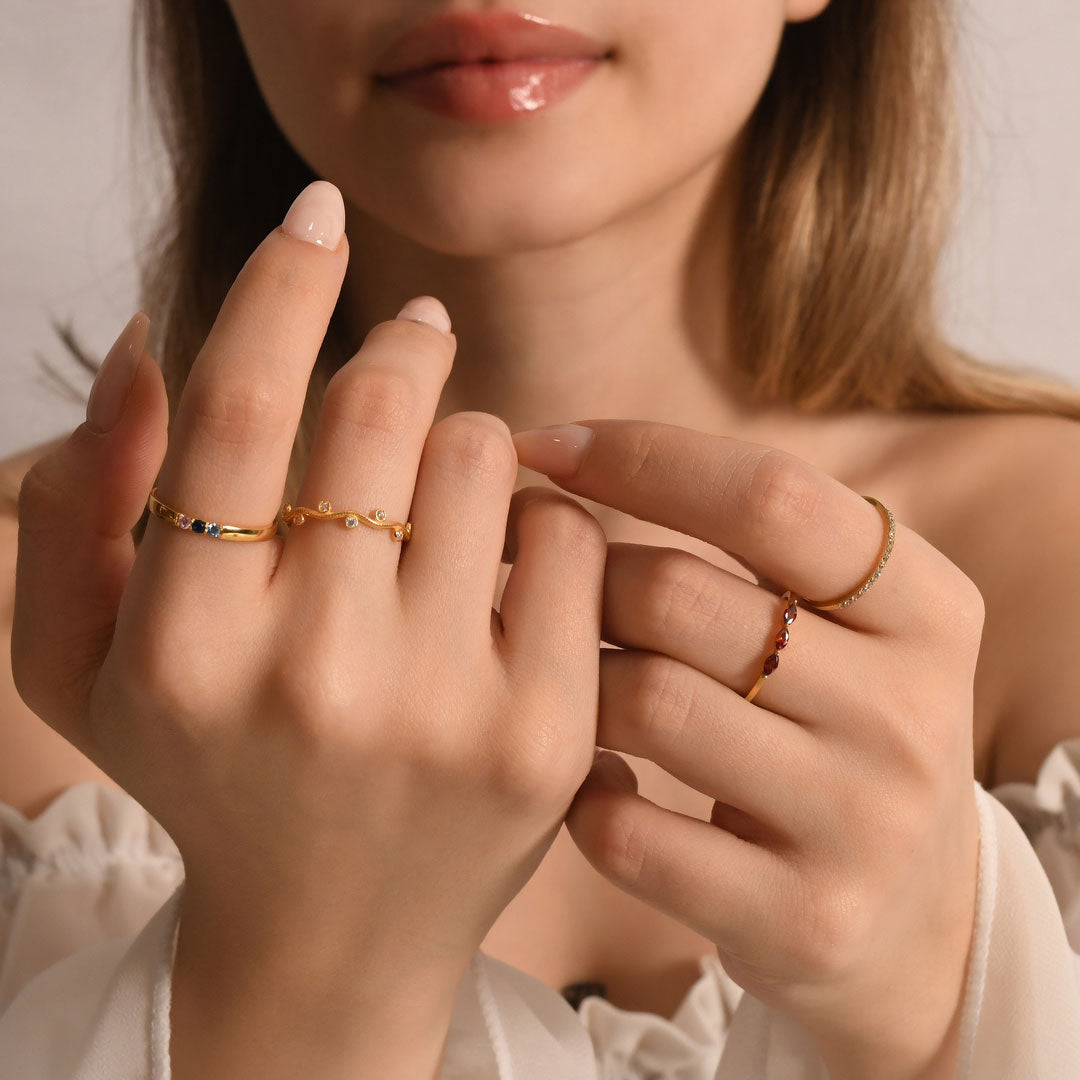


Does 14K Gold Tarnish? 10K, 14K and 18K Gold in Daily Wear
Last updated: November 2026
Solid 14K gold does not rust, peel or flake, and it does not tarnish the way silver does. Because 14K is 58.5% gold and the rest is other metals, it can pick up a light film or lose a little shine over time, mostly from soap, lotion, sweat and chlorine. 10K is slightly more prone to this and 18K the least. A gentle clean brings the shine back.
At a glance
- Pure gold does not tarnish. In 10K, 14K and 18K gold, it is the other metals in the mix that can react.
- The more of these metals a ring contains, the more it can dull: 10K the most, 18K the least.
- Dulling on solid gold is a surface film, not the gold wearing away. Plated jewelry is different, because its thin gold layer can wear through.
- You can wear a solid gold ring every day. Take it off for pools, hot tubs and cleaning with bleach.
- Warm water, mild dish soap and a soft brush are all a solid gold ring needs.
Does solid gold tarnish?
Pure 24K gold does not react with air or water, so it does not tarnish. Gold rings are made from gold alloys: gold mixed with metals such as copper and silver to make it hard enough to wear. These metals can react with sweat, skin products and household chemicals and leave a thin, darker film on the surface.
This film sits on the surface. It is not rust, and the gold underneath is unchanged. That is also the main difference from gold plated jewelry, where the gold is only a thin coating and the metal below can show through once it wears off. If you are not sure what your ring is made of, our guide to whether 10K gold is real gold explains the difference between solid, filled and plated gold.
Does 10K gold tarnish more than 14K or 18K?
Slightly, yes. 10K gold is 58.3% other metals, 14K is 41.5% and 18K is 25%. The more of these metals a ring has, the more easily it can lose some shine. In daily wear the difference between 10K and 14K is small, and a quick clean removes it.
There is a trade-off: the same metals that make 10K more likely to dull also make it the hardest and most scratch-resistant of the three. For a full comparison of durability and color, see 10K vs 14K vs 18K gold.
| Karat | Pure gold | Other metals | Tendency to dull | Scratch resistance |
|---|---|---|---|---|
| 10K | 41.7% | 58.3% | Highest of the three | Highest |
| 14K | 58.5% | 41.5% | Moderate | High |
| 18K | 75% | 25% | Lowest | Lowest of the three |
Can you shower with a 14K gold ring?
Water itself does not harm solid gold, so showering with your ring on will not damage it. Soap, shampoo and body wash can leave a film that dulls the gold and clouds the stones over time. If you keep your ring on in the shower, rinse it well. If you want it to stay bright with less cleaning, take it off.
Can you wear 14K gold every day?
Yes. 14K is one of the most common choices for rings worn every day, because it balances gold content and durability. A few situations are worth taking your ring off for:
- Swimming pools and hot tubs: chlorine can discolor and weaken gold alloys, and hot water makes this worse.
- Cleaning with bleach or strong household chemicals.
- The gym, heavy lifting or hands-on work, where a thin band can scratch or bend.
Why does a gold ring sometimes turn your finger green or black?
A green mark usually comes from copper in the gold alloy reacting with sweat, lotion or salt. It forms a thin film that washes off. It is more common with lower karats and depends a lot on skin chemistry, so one person may see it and another never will.
A black smudge is often caused by makeup, sunscreen or lotion residue rubbing against the metal. Neither mark means the gold is fake. Cleaning the ring and the skin underneath usually solves it. A red or itchy rash is different: that is a skin reaction, so stop wearing the ring and talk to a doctor.
How to clean a solid gold ring
- Soak the ring for about 10 minutes in warm water with a few drops of mild dish soap.
- Brush gently with a soft toothbrush, including under and around the stones.
- Rinse in clean water and pat dry with a soft cloth.
Skip toothpaste, baking soda and bleach, which can scratch or damage the metal. If a film does not come off with soap and water, a jeweler's polish will remove it.
Rings for everyday wear
These designs are made to order in 10K, 14K and 18K solid gold, so you can choose the karat that fits how you live.
Thin milgrain wedding ring
A 1.2 mm band with milgrain edges and gold bead details, set with six small round cubic zirconia stones at the center.
Best for: a ring that stays on every day. 10K or 14K suits this thin band best.
Square black onyx ring
A 3 mm square black onyx center with two round cubic zirconia stones on each side, on a 1.3 mm band.
Best for: a minimal everyday ring that goes with everything.
Browse more by karat: 10K gold rings, 14K gold rings and 18K gold rings.
FAQ
Will 14K gold change color over time?
The gold itself does not change. A ring can look a little duller because of a surface film from skin products and soap. Cleaning with warm soapy water restores the color.
Does 18K gold tarnish?
18K gold is 75% gold, so it is the least likely of the three to dull. It is also the softest, so it scratches more easily than 10K or 14K.
Is a green finger a sign of fake gold?
No. Solid gold rings with copper in the alloy can leave a green mark on some people. To check what a ring is made of, look at the stamp inside the band. Our guide to gold ring stamps explains what each mark means.
About the author
Emre is the founder of Aymir Jewelry. Aymir rings are made to order in 10K, 14K or 18K solid gold in our Istanbul workshop.