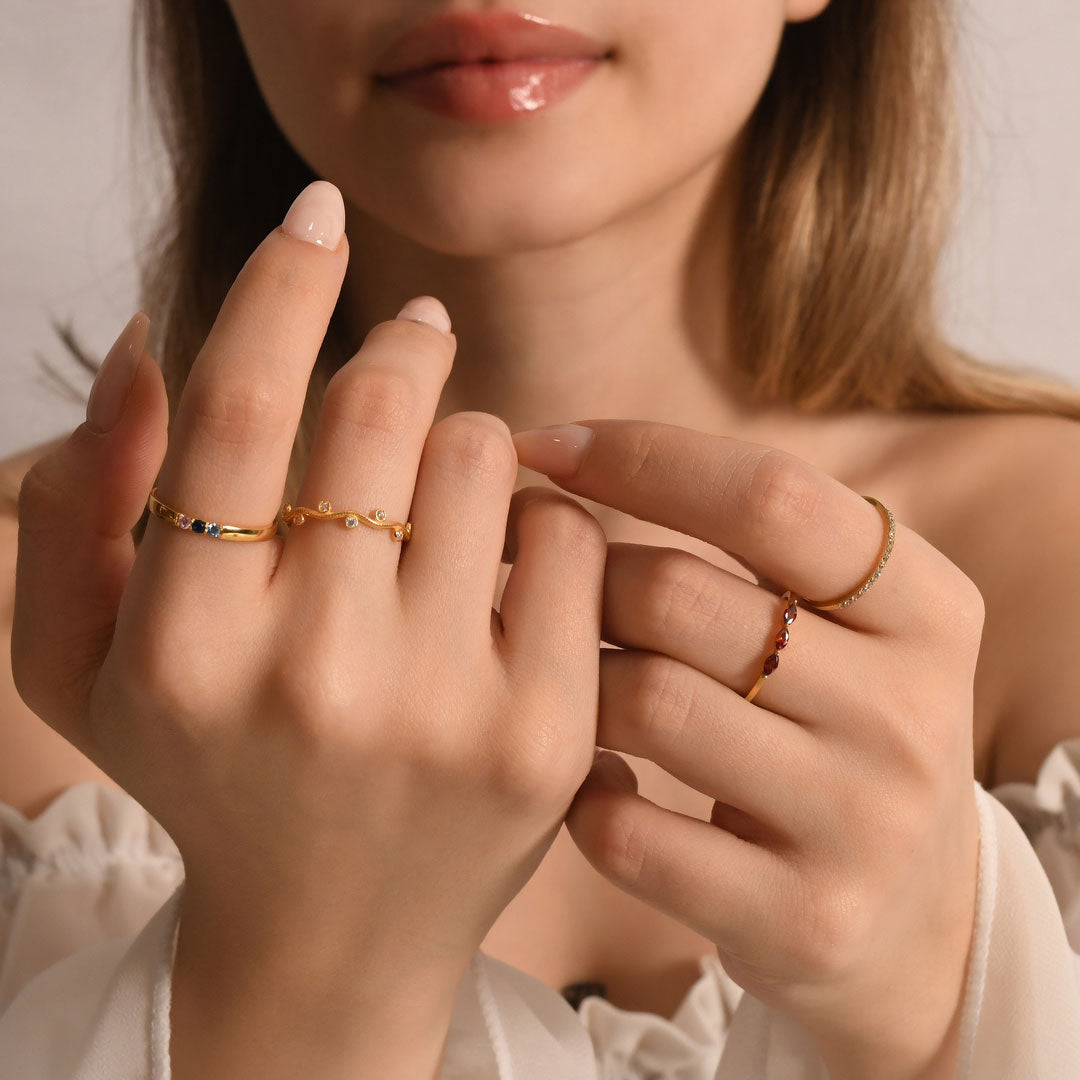


Cubic Zirconia vs Diamond: How to Choose for a Gold Ring
Last updated: November 2026
A diamond is a natural stone and the hardest gem there is, while cubic zirconia (CZ) is a lab-made stone that gives a very similar look for much less money. In a dainty gold ring with small stones, the choice mostly comes down to whether you want a natural, graded diamond and how much of your budget you want to put into the stones, because the gold, the setting and the design can stay exactly the same.
At a glance
- Diamond rates 10 on the Mohs hardness scale. Cubic zirconia rates about 8 to 8.5.
- Cubic zirconia is a lab-made crystal (zirconium dioxide) cut to look like diamond. It is a real stone, just not a diamond.
- CZ throws more rainbow-colored flashes. Diamond looks whiter and sharper.
- Most of our diamond designs are also made with AAA cubic zirconia, in the same stone sizes and the same 10K, 14K or 18K solid gold.
- Our diamond rings use natural diamonds graded F color and SI clarity.
What is the difference between cubic zirconia and diamond?
Cubic zirconia and diamond are two different materials that look alike once they are cut and set. Diamond is crystallized carbon. Cubic zirconia is zirconium dioxide grown in a lab and faceted to imitate diamond, which is why jewelers call it a diamond simulant.
On a ring you wear daily, three differences matter more than the chemistry: how hard the stone is, what its sparkle looks like and what it costs.
| Feature | Natural diamond | Cubic zirconia (AAA) |
|---|---|---|
| Material | Carbon, formed in the earth | Zirconium dioxide, made in a lab |
| Mohs hardness | 10 | About 8 to 8.5 |
| Sparkle | Crisp white light with some color | More rainbow-colored flashes |
| Everyday wear | The hardest gemstone | Hard enough for everyday jewelry |
| Grading | Color and clarity grades (ours are F and SI) | Not graded on the diamond scale; sold by quality letters such as AAA |
| Cost | Higher | Much lower |
Does cubic zirconia look like a diamond in a small ring?
Cubic zirconia looks very close to diamond in a small ring, and the difference is easier to spot in a large center stone than in a row of 1 to 2 mm stones. The visible clue is the color inside the sparkle: CZ flashes more blue, orange and pink, while diamond reads whiter.
The stones on our rings are small. In our diamond designs, round diamonds mostly measure 1 to 2 mm across, and a whole ring usually carries well under a fifth of a carat in total. If you want to know what those numbers mean, our guide to carat total weight on small diamond rings walks through real examples.
How do they hold up in everyday wear?
Both stones hold up well in an everyday ring. Diamond is the hardest gemstone, at 10 on the Mohs scale, and cubic zirconia, at about 8 to 8.5, is hard enough for jewelry worn daily.
Both stones look dull when soap, lotion or skin oil builds up on them, and both brighten again after a wash in warm water with mild soap and a soft brush. The care tips in our guide to gold and tarnish apply to the stones as well.
The band matters too. On a thin everyday ring, the karat of the gold affects how well the ring holds its shape, which is covered in 10K vs 14K vs 18K gold.
How do our diamond and cubic zirconia versions compare?
At Aymir, the diamond and cubic zirconia versions of a design are the same ring with different stones. Most of our diamond designs are also made with cubic zirconia, and the stone sizes listed on both product pages match. The craftsmanship is the same, both come in 10K, 14K or 18K solid gold in yellow, rose or white, and both are made to order in our Istanbul workshop.
What changes is the stones:
- Diamond version: natural diamonds graded F color and SI clarity, with the carat total weight listed on the page. The ring's details are written on a card that ships with it.
- Cubic zirconia version: AAA cubic zirconia in the same sizes.
- Colored center stones: in the diamond version these are lab-created gems such as emerald or ruby (black onyx is natural in both), and in the CZ version they are simulated stones in the same color and size.
F color and SI clarity are explained in our diamond color and clarity chart.
Which one should you choose?
- If you want a natural stone with a diamond grade (F color, SI clarity), choose diamond.
- If you want the same look for less, or you like to rotate rings, choose cubic zirconia.
- If the ring marks an anniversary or a wedding and you want a natural stone, choose diamond.
- If you are adding to a stack and want to test a style first, cubic zirconia is an easy start.
Rings to compare in both versions
Emerald baguette ring with eight diamonds (2S16EME)
Two lab-created emerald baguettes of 3 x 1.5 mm sit side by side, with four 1.25 mm diamonds running down each side, 0.08 ct in total on a 1.30 mm band. The cubic zirconia version of 2S16EME keeps the same layout and sizes. For more on the long, step-cut shape, see what a baguette diamond is.
Best for: an everyday ring with a pop of green.
Beaded milgrain diamond band (2S118)
A 1.20 mm band with milgrain edges and small gold beads, set with six 1.20 mm diamonds at the center for 0.05 ct total. It is a quiet design where the diamonds add light rather than size.
Best for: a slim wedding band or a ring to stack beside an engagement ring.
Black onyx oval with a diamond halo (8S26BLK)
A 6 x 4 mm natural black onyx oval is circled by thirteen 1.30 mm diamonds, 0.13 ct in total. The dark center makes the white halo stand out, so the choice of stone shows more here than on a plain band.
Best for: someone who wants contrast and a bit more sparkle.
North-south emerald baguette (2S35EME)
A single lab-created emerald baguette, 3 x 1.5 mm, set lengthwise between two 1.70 mm diamonds, 0.04 ct in total. With only two side stones, the diamonds stay in the background and the emerald leads.
Best for: a minimal ring on a 1.30 mm band.
Browse more by karat
Diamond designs: 10K gold diamond rings, 14K gold diamond rings, 18K gold diamond rings. Cubic zirconia designs: 10K gold rings, 14K gold rings, 18K gold rings.
Common questions about CZ and diamond
Is cubic zirconia a real gemstone?
Cubic zirconia is a real crystal, made in a lab rather than mined. It is not a diamond, and it is not glass either. It has its own hardness and its own sparkle.
Does cubic zirconia get cloudy?
A film of soap, lotion or skin oil can make cubic zirconia look cloudy, and it washes off with warm water and mild soap. Diamond picks up the same film and cleans the same way.
Can a jeweler tell cubic zirconia from diamond?
Yes. A jeweler can usually tell with a loupe, and a diamond tester gives a quick answer. On a finished ring with tiny stones, the difference is much harder to see with the naked eye.
Are the diamonds in your rings lab-grown?
No. Our diamond rings use natural diamonds, graded F color and SI clarity. Colored stones are listed on each product page as lab-created or natural.
See both versions of a design
Open any ring in our 14K gold diamond rings collection and switch the stone option to see the cubic zirconia version of the same design. If you want a design in a different stone layout, send us a message and we will tell you what is possible.
About the author
Emre is the founder of Aymir Jewelry. Aymir rings are made to order in 10K, 14K or 18K solid gold in our Istanbul workshop.